

Last Updated: October 25, 2026
Quick Summary
The best heat press for high volume production is an automatic or pneumatic machine built for continuous 8 to 12+ hour shifts, not a manual press. Match the machine to your busiest week: dual-station pneumatic between 100 and 400 pieces a day, automation above 400.
- High-volume production means running 8 to 12+ hours per shift, 5 to 7 days per week.
- The APEX X6 rotary processes up to 420 garments per hour with minimal labor.
- Dual-station pneumatic presses cut effective cycle time to roughly 25 to 35 seconds per garment.
- Skip pneumatic and stay manual if you press under 50 pieces a day.
- Size the press to your busiest week and promised turnaround, not your average day.
Table of Contents
- What Counts as High-Volume Heat Press Production?
- Quick Comparison: High-Volume Heat Presses Side by Side
- Why a Commercial Heat Press Machine Changes the Math
- Automatic Heat Press Machine Options for Scale
- When a Pneumatic Heat Press Machine Makes Sense
- Platen Size and Press Type: Matching the Machine to the Garment
- Building a Heat Press Production Workflow That Holds Up
- Choosing the Right High-Volume Heat Press for Your Shop
- Frequently Asked Questions
What Counts as High-Volume Heat Press Production?
The best heat press for high volume production is built for long, continuous shifts rather than occasional jobs.
At McLogan, we've supplied presses since 1922, and the pattern is consistent: shops that buy for peak volume rarely regret it, while shops that buy for average volume replace equipment within a year.
Below, we'll show you exactly how to match a machine to your real order volume, and where most buyers overspend or underspend.
Quick Comparison: High-Volume Heat Presses Side by Side
Here's how the main options stack up before we get into the details.
| Press | Price | Stations | Best For |
|---|---|---|---|
| APEX X6 Rotary | $36,990 | 6 | Maximum throughput, minimal labor |
| APEX Max Roll-to-Roll 16x20 | $10,990 | 1 | Automated DTF film handling |
| Atlas Ultra 40x48 | $12,990 | 2 | Oversized and all-over sublimation |
| TITAN Dual Station Pneumatic | $3,290 | 2 | Growing shops moving to air power |
| VECTOR Dual Station Pneumatic | $2,499 | 2 | Entry-level pneumatic production |
The gap between a $2,499 press and a $36,990 press is not marketing. It's labor, cycle time, and repeatability.
Why a Commercial Heat Press Machine Changes the Math
A commercial heat press machine changes the math because it removes the operator from the cycle. Manual presses depend on a person closing, timing, and opening every press.
The market reflects the demand. Dataintelo reports the heat press machine market was valued at $1.82 billion in 2025 and projects $3.47 billion by 2034, a 7.4% compound annual growth rate, per Dataintelo's market forecast.
The real calculation is total cost of ownership. A press that saves 15 seconds per cycle across 400 cycles a day buys back hours of labor weekly.
Automatic Heat Press Machine Options for Scale
Automatic heat press machines are the right call when labor, not equipment, is your bottleneck. Where Crafting Happens notes that an automatic press is best for high-volume production, per Where Crafting Happens' press guidance, and the reasoning is straightforward: automation standardizes every cycle.
Our top pick for serious scale is the APEX X6 6 Station 16 x 20 Fully Automatic Rotary Heat Press.
For DTF shops, the APEX Max Roll-to-Roll systems automate film feeding, alignment, pressing, and peeling, producing roughly 230 to 250 garments per hour.
Watch out: automation only pays off if your upstream process can feed it. A rotary press starved of prepared garments is just an expensive table.
When a Pneumatic Heat Press Machine Makes Sense
A pneumatic heat press machine makes sense when you want consistency and less operator fatigue without jumping to full automation.
Coastal Business identifies pneumatic presses as suited to commercial, higher-volume apparel work, per Coastal Business' heat press guide.
The TITAN 16 x 20 Auto/Semi-Auto Dual Station Pneumatic Heat Press is our pick here.
Best for: shops pressing several hundred pieces a week that want repeatability. Skip if: you're under 50 pieces a day.
Platen Size and Press Type: Matching the Machine to the Garment
Platen size and press type should follow the garment, not the other way around. A 16x20 platen covers most T-shirts and standard apparel.
InkSonic notes that a DTF production press should deliver even heat, consistent adjustable pressure, and a platen sized to the transfers, per InkSonic's DTF press criteria.
For oversized graphics and all-over sublimation, the Atlas Ultra 40 x 48 Pneumatic Sublimation Double Station Heat Press offers a 39.4 x 47.2-inch platen with dual pneumatic cylinders for even pressure edge to edge.

Clamshell presses suit tight spaces. Swing-away presses keep the heating element clear of the loading area. Dual-station designs split the difference and keep production moving.
APEX X6 - 6 Station 16” x 20” Fully Automatic Rotary Heat Press - With Preheat →
Building a Heat Press Production Workflow That Holds Up
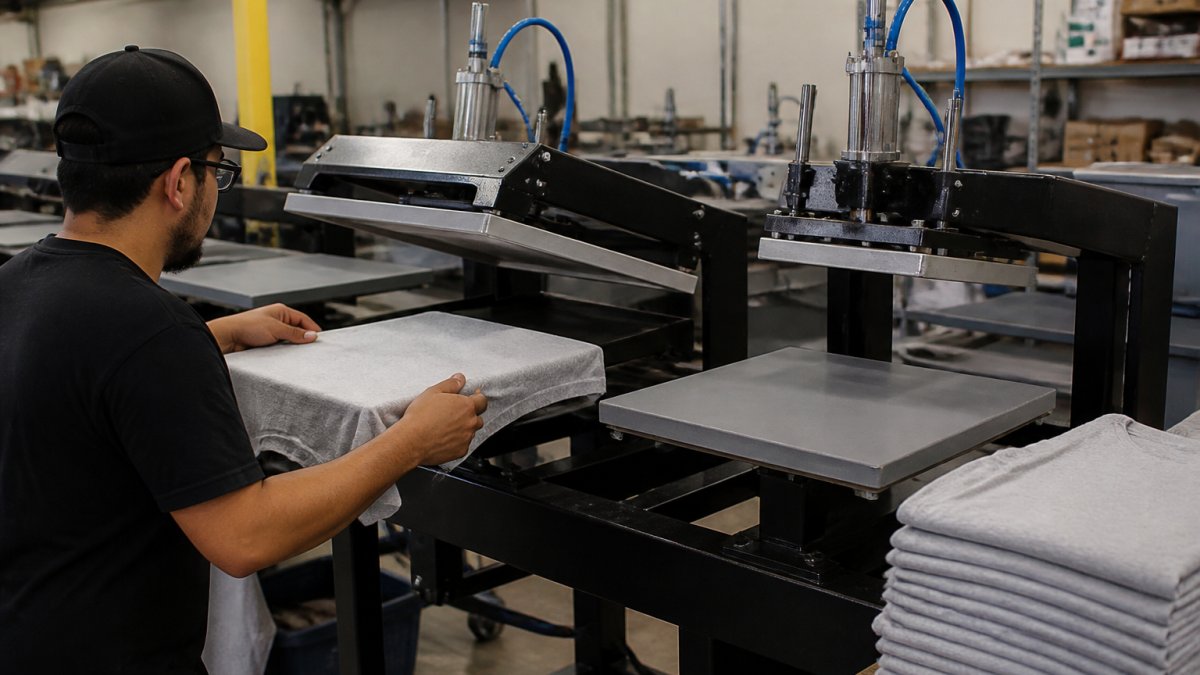
A heat press production workflow holds up when loading, pressing, and unloading never wait on each other. That usually means two stations, preset job settings, and a clear staging area.
Measure cycle time before you buy
Most buyers compare presses by platen size and price. Production buyers compare them by seconds per garment. Break every cycle into four parts: load, press dwell, unload, and fold or stack.
Run the math on your own numbers. If you press 300 shirts a day and each cycle takes 50 seconds, that is 4.2 hours of pure press time before breaks, setup, or reprints.
Design the staging area around the press
A press starved of prepared garments is just an expensive table. Lay out three zones within arm's reach: a pre-press stack of prepared garments and transfers, the press itself, and a post-press stack for cooling and folding.
A common pattern in shops running several hundred pieces a day is a U-shaped cell: pre-press on the left, press in the center, peel and fold on the right, with the operator standing in the middle.
Set presets by fabric, not by job
Set three presets for your most common jobs: one for cotton tees, one for poly blends, one for specialty fabrics. Recall beats re-dialing every run. Label them by fabric and transfer type rather than by customer name, because the same customer will send you a cotton order and a poly order in the same week. On a touchscreen-controlled press, store the preset with temperature, pressure, and dwell time together so a new operator cannot mix settings from two different jobs.
Control consistency with a simple log
Keep a maintenance log. When issues do come up, this heat press troubleshooting guide walks through fixing common problems to avoid downtime. Worn platen covers and drifting thermostats cause more bad transfers than operator error. Log three things daily: the press's displayed temperature versus a surface probe reading, the pressure setting, and any reprints caused by transfer defects. A platen cover that has compressed or glazed will show up as uneven transfers at the edges before it fails outright.
Plan for operator fatigue on long shifts
High-volume pressing is physical work. Heat exposure, repeated reaching, and standing in one spot for eight to twelve hours cause more output loss than most buyers expect. Set the press at a height where the operator's forearms are roughly parallel to the floor at the loading position, keep a heat-resistant glove on the loading hand, and ventilate the area so the press's radiant heat does not build up.
Choosing the Right High-Volume Heat Press for Your Shop
Choosing the best heat press for high volume production comes down to three numbers: pieces per day, operators per shift, and budget per unit of output. For a closer look at reliable presses for small businesses scaling up, see this guide to reliable heat presses for small business. Write them down before you shop.
Build a capacity plan from order volume
Start with your busiest week, not your average week. Count the pieces you must ship in that week, divide by the number of production days, and that is your daily throughput target.
Layer in product mix. A shop pressing mostly standard cotton tees can plan around a 16x20 platen and a 30-to-50-second cycle. A shop doing oversized graphics, all-over sublimation, or heavy blends needs a larger platen and longer dwell, which cuts throughput per hour.
Match staffing to machine type
Staffing is the variable most buyers underweight. A manual single-station press needs one operator per press and caps output at that operator's pace.
A practical rule: if you are hiring a second or third press operator to keep up, price the labor against the cost of a machine that removes the second operator from the cycle. The machine often wins over a two-to-three-year horizon.
Set a turnaround target and work backward
Turnaround targets drive machine choice as much as volume does. A shop promising 48-hour turnaround on custom orders needs slack capacity and fast changeover between jobs, which favors preset-driven touchscreen controls and dual stations. A shop running large batch orders with week-long lead times can optimize for raw throughput and accept longer changeover. Write down your promised turnaround, then check whether the machine you are considering can hit it on your busiest week with one operator out sick.
Use a simple decision framework
If you're pressing under 100 pieces a day, a dual-station auto-open press like the Vector at $1,599 handles it. Between 100 and 400, step up to pneumatic. Above 400, automation earns its price. Within each tier, choose platen size by your largest common garment and choose station count by how many operators you can staff.
McLogan has supplied printing and sign equipment since 1922, and our team can help you size a press against your actual volume rather than a guess.
Frequently Asked Questions
What features matter most in a high volume heat press?
Prioritize repeatable time, temperature, and pressure over headline speed. A press that holds the same settings on every cycle removes operator variation, which is the main cause of uneven transfers. Dual-station or rotary platforms cut idle time between loads, and a real-time pressure display plus preset memory slots make changeovers faster. Build quality and heat retention matter as much as cycle time.
Is a pneumatic heat press machine better for production than a manual press?
For long shifts, yes. A pneumatic heat press machine uses air pressure to close and open the platen, so the operator is not pulling a handle hundreds of times a day. That reduces fatigue and, more importantly, applies the same pressure on every cycle regardless of who is running the machine. Manual presses can produce good transfers, but output and consistency depend heavily on operator technique. Pneumatic models require an external air compressor, which is sold separately on the TITAN and VECTOR lines.
How do you choose the right platen size for a production heat press?
Match the platen to the largest transfer you run most often, not the largest you run occasionally. A 16 x 20 inch platen covers standard front and back T-shirt prints and is the common production size. Step up to a large-format platen such as the 39.4 x 47.2 inch surface on the Atlas Ultra when you produce all-over sublimation, oversized graphics, or full-panel garments. Undersized platens force repositioning and slow the workflow; oversized platens waste heat and floor space on small jobs.
How can a print shop improve heat press output and consistency?
Remove manual steps from the cycle. Dual-station presses let one operator load the next garment while the current one presses, and automatic roll-to-roll systems handle film feeding, alignment, and peeling without intervention. The APEX X6 is rated to process up to 420 garments per hour with minimal labor, while the APEX Max roll-to-roll models run roughly 230 to 250 garments per hour. Pair that automation with preset settings and laser alignment so each job starts from the same baseline.
What is the best heat press for high volume production on a tight budget?
Start with a dual-station auto-open press rather than a single-station manual unit. The Vector 16 x 20 Double Station Auto-Open Heat Press at $1,599 lets you press one item while loading the next, which is the single biggest workflow gain for a growing shop. If you need air-powered consistency, the TITAN 16 x 20 Pneumatic Slide-Out Heat Press at $2,590 adds pneumatic operation and a slide-out platen for easier loading, with an air compressor purchased separately.
The hardest part of scaling isn't buying the press. It's matching capacity to demand so you're neither idle nor backed up. McLogan carries professional-grade heat press equipment with expert guidance, a catalog built for growing shops, and staff who know screen printing and sign design. Get started with McLogan and put the right press on your floor.


